This month’s Business Valuation Update published by Business Valuation Resources (BVR) featured my article about implementing a “COVID-19 Marketability Discount”. This is a Discount for Lack of Marketability (DLOM) that arises due to an unusual amount of risk because of COVID-19 and the related economic fallout affecting small and micro businesses.
The methodology used to determine a COVID-19 Marketability Discount can be applied as a separate discount or it can be used as a basis to adjust the historic information based market method multiplier or income method company specific risk premium (SCRP). In many current situations, due to the risk presented by COVID-19, our historic data sources (market method data bases and income method build-up data (BUM method)) do not adequately address the short term risk that is currently being placed on small businesses and their valuations
Micro and very small businesses generally cannot provide forecasts. Therefore the valuation analyst has to use a single period valuation method. As is always the case, the cash flow should be adjusted to reflect the most likely future. But, if the analyst believes an economic recession or 2nd waive of the virus could further impact cash flows there is likely to be more risk to these future cash flows than that reflected in the historic data. Assessing that risk and making an appropriate adjustment is the purpose of this COVID-19 Marketability Discount.
Alternative method: In a new article, an analyst reports that he has been using a “COVID-19 marketability discount” on control interests to make the extra risk adjustment.
“In many situations, I favor the methodology of showing a separate COVID-19 marketability discount,” says Greg Caruso (Harvest Business Advisors), “because it clearly shows the valuator’s thought process and the actual discount being applied for the current high level of uncertainty.”
His methodology is based on the weighing of factors such as those used in Mandelbaum and the IRS DLOM Job Aid but with categories modified to fit the current situation.
Caruso first developed this technique to use in a valuation for an SBA loan. The company was temporarily shut down and appeared to be fully recovered on a monthly cash-flow basis for the two months after reopening. Yet, there was still risk of another shutdown and customers would have economic issues if a recession hit, so Caruso’s basic capitalization rate was a buildup for “normal times,” which included a normal company-specific risk that he further discounted by the COVID-19 marketability discount.
Caruso explains his methodology and presents a case study in more detail with a sample analysis in the November 2020 issue of Business Valuation Update.”
I am grateful to BVR for their support through the years. They are truly a valuable resource.
In the upcoming weeks, I will be conducting several webinars on this topic. Please visit the Events Page for more details.
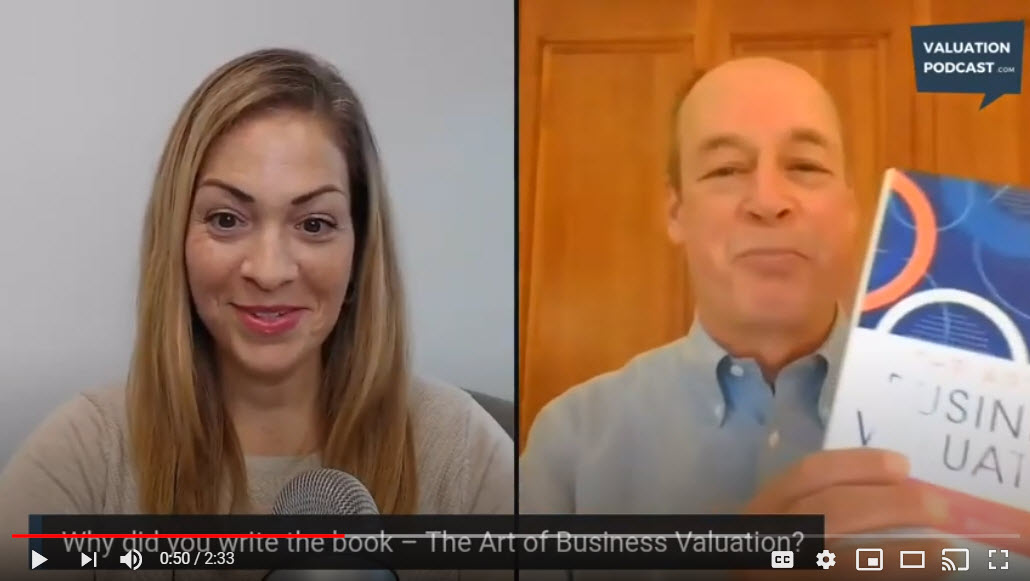
The book, “The Art of Business Valuation, Accurately Valuing a Small Business” has over 400 pages covering many aspects of small business valuation and market sales including working with business brokers, increasing sales value, descriptions of a well-run sales process, due diligence including a checklist and guidance on SBA loans.
If you value or use valuations of businesses with revenues under $10 million, you need this book on your desk. The book published by Wiley is available through your favorite bookseller or directly from Wiley.
Finally the author, Greg Caruso, JD, CPA, CVA, is always available to assist with exit planning, brokerage, and to prepare or review business valuations with an emphasis on increasing value and likely transaction values and terms.
“The Art of Business Valuation, Accurately Valuing a Small Business” covers many aspects of small business valuation and market sales including working with business brokers, increasing sales value, descriptions of a well-run sales process, due diligence including a checklist and guidance on SBA loans.
If you value or use valuations of businesses with revenues under $10 million, you need this book on your desk. The book published by Wiley is available through your favorite bookseller.
Finally the author, Greg Caruso, JD, CPA, CVA, is always available to assist with exit planning, brokerage, and to prepare or review business valuations with an emphasis on increasing value and likely transaction values and terms.
Greg is available for interviews, podcasts, quotes, presentations and more. Contact Greg at or 609-664-7955.
I am grateful to my friend and colleague, Ron Rudich, for writing the Foreword to “The Art of Business Valuation: Accurately Valuing a Small Business”.
FOREWORD
This book, The Art of Business Valuation: Accurately Valuing a Small Business is an important guide and desk reference for valuing small businesses under $10 million in revenues. The vast majority of businesses are this size, yet most business valuation books, even the ones claiming to be for small businesses, do not address the unique factors impacting these small and very small businesses.
The author’s business broker and valuation background provides a practical view of technical valuation issues from someone who has had to then “find the number” in the market. Yet this is not a book about price. It is about business valuation, namely, finding a business value for a specified interest as of a specified date to a specified standard of value.
My contribution to this work has been to provide insight and modification as an experienced practitioner, instructor, and mentor from a more technical accounting business valuation view.
The book’s focus on small businesses does not mean that methods or techniques have been simplified or ignored. What has been provided is a thorough examination of how valuation methods really work with the data that is really available for these businesses. Things like,
how to work with less than perfect financial information
how to find a highly supportable multiplier using available data
when to use the market or the income method
how to meet valuation standards
and more.
Included in the book are detailed figures, tables, explanations, and on the related website working Excel files and even sample reports that provide a framework that can be adapted to most business valuation needs.
Lastly, while an exact “opinion” may only be supportable and not be accurate, our methods, work product, and reports can and should be accurate. That is the standard we all must strive for every day in every engagement. That is why accurate is in the sub-title.
Clearly, the best a valuator can do is issue an “opinion.” Therefore, there will be varying viewpoints on the topics and methods presented here. In fact, there will be situations where the facts and assumptions would dictate that we use different techniques than the ones recommended here. That illustrates the importance of professional judgment.
That is the Art of Business Valuation.
We find this variety of viewpoints and challenges to our thoughts to be exciting and invigorating. It makes business valuation better. With this view in mind, please contact us at with your thoughts on the book and the valuation of small businesses. We also would be pleased to receive additional reports, studies, techniques and other viewpoints that can be posted on our related website www.theartofbusinessvaluation.com.
This way, we can all continue to learn, grow, and improve together.
The book, “The Art of Business Valuation, Accurately Valuing a Small Business” has over 400 pages covering many aspects of small business valuation and market sales including working with business brokers, increasing sales value, descriptions of a well-run sales process, due diligence including a checklist and guidance on SBA loans.
If you value or use valuations of businesses with revenues under $10 million, you need this book on your desk. The book, published by Wiley, is available through your favorite bookseller.
Greg Caruso, JD, CPA, CVA, is always available to assist with exit planning, brokerage, and to prepare or review business valuations with an emphasis on increasing value and likely transaction values and terms.
Greg is also available for interviews, podcasts, quotes, presentations and more. Contact Greg at or 609-664-7955.
The following are quotes related to small business valuation, business owner succession or exit planning, business brokerage, SBA and more from “The Art of Business Valuation, Accurately Valuing a Small Business,” by Gregory R. Caruso, published by Wiley, 2020, ISBN: 978-1-119-60599-7
You are authorized to use these quotes by providing the following reference to the book, Caruso, Gregory, “The Art of Business Valuation, Accurately Valuing a Small Business”, 2020 Wiley, along with the page number. If there is not a page number, then it is just a quote of the author, Greg Caruso. If possible referencing this website www.theartofbusinessvaluation.com is always appreciated.
Micro and Small Business Valuation in the age of Covid-19
“Small business is under unbelievable stress from Covid-19 related economic issues varying from shut-downs to product shortages. Business valuation is based on future cash flows of the business. Micro and small businesses have a difficult time projecting cash flows in stable times which has become greatly magnified in the current environment. Yet outside a few “loser” industries and locations good businesses and good business people will preserver and create business value. As business valuators our job is to apply valuation basics along with professional judgment to properly assess business value and assist owners in growing that value particularly in times of uncertainty” Gregory Caruso, Author, “The Art of Business Valuation, Accurately Valuing a Small Business,” Wiley 2020
“How does one equate a large number of deaths, 10%+ unemployment, and a soaring stock market (at least as of August, 2020) when trying to predict the future cash flows of a small local business?” Yet this is what business valuation analysts do. The reliance on basic valuation principals augmented with professional judgement is how we value micro and small businesses in this environment. After all, business people will continue to need business valuations to buy, sell, get divorced, obtain loans etc. even in these uncertain times. Gregory Caruso, Author, “The Art of Business Valuation, Accurately Valuing a Small Business,” Wiley 2020
What creates errors in business valuation?
“Most major errors in business valuation are the result of missing facts or patterns and misinterpreting those facts or patterns, not from the improper application of the model. For instance, failing to factor in falling fuel prices into a bus company valuation that results in a very high valuation. P.26
Why is it hard to prepare a business valuation for Main Street, micro, and very small businesses?
“Small and very small businesses are just not very good at data collection, much less providing it to third parties. Most small business owners manage by walking around. In addition, the best owners have a few indicators that tell them where they stand; perhaps incoming orders and cash balance; perhaps today’s cost of goods. They have their one or two simple indicators and a feel for the business. This way owner/operators can run great businesses and keep overhead down. While this limits long-term growth, it creates significant overhead efficiencies. Consequentially, this lack of data makes economic and business sense.” P. 29
What is the Art of Business Valuation?
“No matter how complex a company or situation may seem while working through a valuation, when complete, the valuation analyst should be able to provide a concise and clear analysis. If the analyst cannot do that, then more work is needed. Being able to simplify is a major indication that you are achieving the Art of Business Valuation.” P.37
“Small businesses have less quantifiable financial data. Therefore, more reliance must be placed on qualitative, or soft data. This requires more professional judgment, hence, Art in performing a business valuation.” Gregory Caruso, Author, “The Art of Business Valuation, Accurately Valuing a Small Business,” Wiley 2020
Importance of business systems
““Quality business systems are when average people get extraordinary results every time.” Use this as the standard to determine systems. One indicator is if there are, “lots of reasons why things are not working,” generally, their systems do not work. P. 52
Importance of people to business value
“Does the business have a culture of: “forever and continuous improvement” or resiliency in the face of problems?” These two factors often are the biggest indicators of future success or failure. They also are cultural matters that may be hard to quantify.” P.55
Why is small business more risky than larger businesses?
“Concentrations kill. Concentrations are the main reason why small businesses are so much riskier than larger businesses. A large customer or supplier or other concentration can cause major disruption and bankruptcy when relationships end. Small and very small businesses have all sorts of concentrations. Many concentrations are unavoidable at least for periods of time. This include, customer concentrations, product concentration, supplier concentrations, referral concentrations, geographic concentration, key people concentration, commodities risk concentration.” P.60
Valuation Discounts, (Primarily Lack of Control and Marketability Discounts (DLOM))
“The purpose of a discount is to fully factor adjustments between the interest being valued (usually partial ownership) in the subject company and the comparables that are not fully accounted for elsewhere in the valuation model. Discounts are even more justified with small and very small companies due to the high levels of risk because of owner relationships, limited customers, limited suppliers, small geographic market, limited management depth, etc. These concentrations create volatility and risk that do not exist with larger companies and often are not fully accounted for in market data, capitalization rates, and discount rates.” P. 252
Exit Planning For Business Owners
“Many employees when asked, “Would you like to be an owner?” hear, “Would you like an upside bonus plan?” not personal guarantees and real ownership risk. This requires a clear and detailed conversation – early.”
“One area that could use more focus is the emotional side of the business exit and purchase process. Buying or selling a business is a major life change. It is stressful and difficult for most people. Numbers are easy compared to emotion and fear. Therefore, most people, even those who should know better, just avoid the topic.” P. 318
“Owners are sellers when their TIME is worth more than their MONEY. Most owners are not sellers because their business is how they want to spend their time. Their business is worth more to them than other potential owners. That is why business brokers are so concerned about what owners are going to do next. The void of time becomes bigger as closing gets closer.” P.324
What business buyers want
A “working model” to generate the cash flow. This means systems that work today. People who can operate the systems today who are staying after the sale.” P.325
“A very clear buyer adage is, “If you want to be paid for it, prove it.” In other words, buyers pay for what exists. An apple seed has the potential to be an apple tree. But no one pays for the tree when they are getting the seed.” P. 325
SBA 7(a) Business Loan Program
“Prior to the SBA most small transactions required the seller to finance as there was no one else…… This is rarely necessary with cash flowing businesses any more. In the last 25 years the SBA has removed these issues and brought stability to the market.
It appears that part of the reason why transaction sale data has become more useful is because there are more consistent transitions. In the end, most sellers take the SBA’s loan amount and the sale price is reasonably close to the loan amount. Few sellers want the risk associated with providing financing. The availability and stability of financing have brought predictability to the small and very small business sale market” p. 337
“Should the SBA program be restricted or if the terms for obtaining an SBA loan become very restrictive (for instance, requiring 35% down instead of the current 10% down), the value of small and very small businesses will be greatly impacted. This is yet another assumption underlying most small and very small business valuations that no one even thinks about.” P. 338
Business brokerage in the business sale process. How to maximize a price?
“The point of the business brokerage process is to make a market across the likely buyer pool for the business…… The goal is to get three or more LOI’s (Letters of Intent or preliminary offers) at about the same time to allow negotiating power on behalf of the seller and to verify the market….. Fear of loss brought on by multiple bidders is what creates negotiating power.” P. 345
“Businesses are selling current cash flow. Many a seller becomes so focused on the sales process that their profits fall, reducing value. A good business broker minimizes this distraction. After all, sellers need to run their businesses like they will never sell.” P. 350
Reviewing a Business Valuation
“Finally, does this make sense? Given the overall fact pattern, would someone pay a price that reasonably relates to the value found, based on the facts both specified and the reasonable assumptions with what was known or knowable on the valuation date?” p.394
The book, “The Art of Business Valuation, Accurately Valuing a Small Business” has over 400 pages covering many aspects of small business valuation and market sales including working with business brokers, increasing sales value, descriptions of a well-run sales process, due diligence including a checklist and guidance on SBA loans.
If you value or use valuations of businesses with revenues under $10 million, you need this book on your desk. The book published by Wiley is available through your favorite bookseller.
Finally the author, Greg Caruso, JD, CPA, CVA, is always available to assist with exit planning, brokerage, and to prepare or review business valuations with an emphasis on increasing value and likely transaction values and terms.
Greg is available for interviews, podcasts, quotes, presentations and more. Contact Greg at or 609-664-7955.
Standard of value is a shorthand for describing who is the buyer and who is the seller and what is the framework for the transaction in a business valuation.
For instance a race car has a very different value to a race car driver than it would to a family of six looking for a safe car. The value is also likely to be different if the seller must sell in a week or has three months to make a deal.
While this distinction can be subtle, it can shift the found value significantly. For instance a Fair market value and fair value valuations regularly have a 15-30% or more value variance. A brief explanation of the primary (but not all inclusive) standards of value follow.
Fair Market Value
“The amount at which the property would change hands between a willing buyer and willing seller, when the former is not under any compulsion to buy, and the latter is not under any compulsion to sell, both parties having reasonable knowledge of relevant facts.” Rev. Ruling 59-60.
Other important points that, while not in the above definition, are agreed upon by the valuation community:
This payment is in cash or immediately available funds (which means it will be cash within three days). Basically this is a typical buyer and a typical seller transaction at an all cash price.
The buyer and seller are hypothetical not the actual parties.
Finally fair market value is often not the highest price that might be obtained. It is a likely price by a financial buyer with no synergies unless many buyers have the synergies.
The fair market value standard, when used to value minority and lack of control interests, will require discounting or other adjustments. The owner’s of these lack of control interests do not have the ability to control the company, (the difference between being the driver of the car and in the passenger seat) hence their shares are difficult to sell and garner much lower prices than control owners. Discounting is, in effect, a second valuation that reduces the value found from company value to the specific minority owner’s interest value.
Fair Value
Definitions vary, but for litigation and state law purposes, it is usually the fair market value of 100% the equity interests in the enterprise that are then divided pro-rata based on ownership percentage. There are no discounts for minority interest or discounts for lack of marketability for lack of control shareholders. Again, these are the discounts that arise from being “along for the ride” instead of in control of the company. State statutes and in litigation by courts of equity frequently use Fair Value to protect minority shareholders. (Please Note: Fair Value in GAAP public accounting has a different definition but that is rarely applicable to small and very small businesses and will not be addressed here.)
Synergistic Value
Synergistic Value is the value to a buyer where the buyer can make more money from the acquired company than the acquired company could on its own. Consider two delivery companies with half empty trucks going on the same routes. Surely if one acquired the other the successor would be more efficient and profitable. This is Synergistic Value.
If there are many synergistic buyers, then synergistic value may actually equal fair market value. If synergistic buyers are rare, then fair market value will be below synergistic value.
Investment Value
Investment Value is a market value where the buyer and seller are known. This valuation would attempt to use actual revenues and expenses to determine cash flows from the two companies. Investment value may be synergistic or not.
Remember fair market value is NOT the actual buyer and seller but a representative hypothetical typical buyer and seller.
Liquidation Value
Liquidation Value is the value of the assets that must be sold in a defined time frame. Orderly liquidation assumes about a 90 day sales window. Assets must be sold promptly but there is some time to make a market. Forced liquidation is also known as auction value, the price when the asset will be sold on a set date.
Clearly the standard of value selected will greatly impact the value found in a business valuation.
Do you need a valuation for your business or for your clients?
Do you prepare or review business valuations?
Do you advise business owners based on business valuations as their attorney, accountant, or financial planner?
Do you ever refer your clients to a Certified Valuation Analyst?
Market Approaches in business valuation compare market sales to the company being valued. This is done by estimating a ratio of sales price to cash flow called a multiple or multiplier (i.e. $300 sales price / $100 of cash flow = a multiplier of 3.) Then the selected multiple is applied to the same estimated cash flow of the subject company to determine a value.
Thereafter the multiplier is multiplied against the subject company cash flow to obtain an estimate of value.
Business brokers often have “rules of thumb” that use the market method formula. For instance deli’s sell for 35% of revenues. This is not based on research and detailed thought, just a form of common knowledge. Technically, that does not reach the level of a valuation as it is unlikely to be supportable.
Two primary Market Methods are most frequently used by valuators are:
The Public Company Guideline Comparable Method which uses stock prices from similar public companies. This methodology is really not suitable for most small and very small business valuations as large companies tend to be quite different from small ones. Namely, is Home Depot like your corner hardware store?
The second method is the Private Company Guideline Comparable Method.
The Private Company Guideline Comparable Method uses transaction data from private company sale databases. DealStats, Bizcomps, and Valusource Market Comps are all good sources for small and very small business comparables.
Typically, the valuator will start the process to find comparables by searching for the industry by NAICS (North American Industry Classification System) or SIC (Standard Industrial Classification) system codes. Depending on the number of results (at least 8-10), the valuator may add related codes or narrow the search by company size based on revenues and perhaps profitability based on profits or a defined cash flow. Comparable data is then reviewed using key word sorts, detailed data, charting and graphing results based on cash flow profitability and other indicators to see how similar it is to the subject company. These reviews are very detailed and complex.
Finally, a multiplier is selected by reviewing the comparable data and the subject company for both financial information and soft data. (These resources can include both internal such as concentrations, management strength, systems, etc. and external such as the economy and industry).
This process requires both skill at analyzing the data and professional judgment. But, for small and very small businesses (also known as micro-businesses), the market method is the only method of business valuation that can really be tied into market data.
Typical cash flows used for valuation may include:
revenues
gross profit
EBITDA (earnings before interest, taxes, depreciation, and amortization)
SDE (seller’s discretionary earnings which is EBITDA plus all the ways one owner makes money from the business)
Each has advantages and disadvantages. The choice should be based on the fact pattern of the business and, of course, the available, selected comparable data. In general, in less experienced valuators hands, EBITDA or SDE tend to result in more useful values than the other possible cash flow choices. This is because people buy businesses based on the amount of money they think they will make in the future owning the business.
In many cases, a final adjustment needs to be made for assets or liabilities on the balance sheet beyond those typically conveyed for the price specified in the market data database.
An example of this is that in many retail businesses inventory purchased by the buyer is added to the value found based on cash flow.
The Market Method for providing an opinion of value of a business is often complex and relies heavily on experienced professional judgment. With a skilled valuator, the Market Method is the best method for valuing most small businesses with revenues below $5,000,000 and should be reviewed carefully for valuing companies with revenues up to $10,000,000 or more.
Do you need a valuation for your business or for your clients?
Do you prepare or review business valuations?
Do you advise business owners based on business valuations as their attorney, accountant, or financial planner?
Do you ever refer your clients to Certified Valuation Analyst?